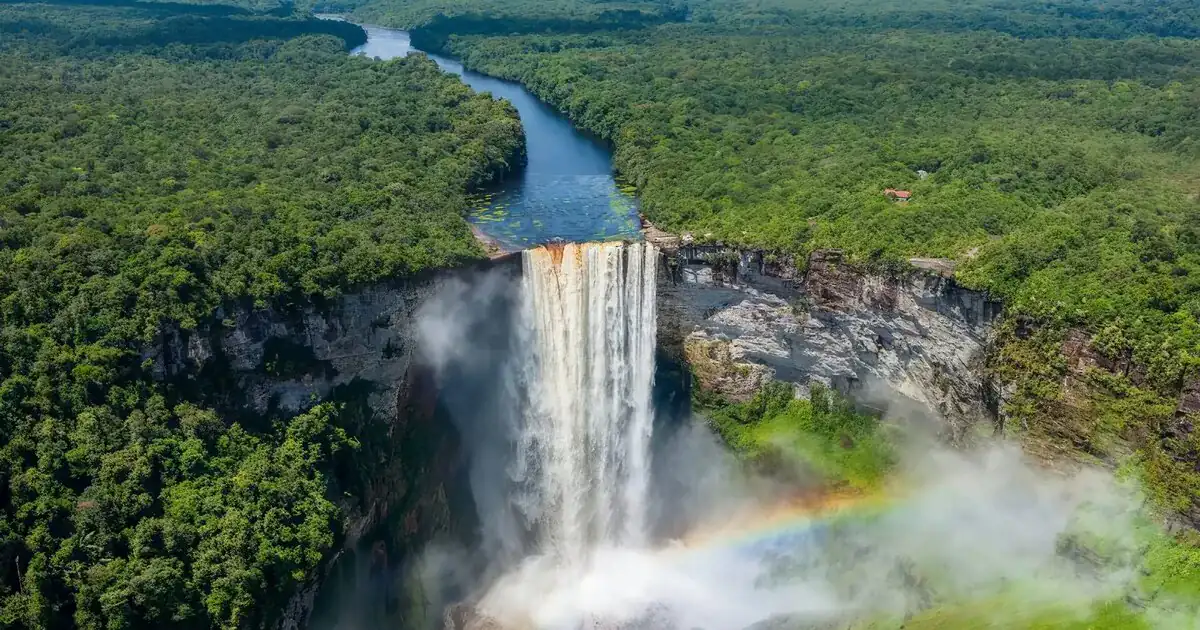
Kaieteur Falls
The World's Largest Single-Drop Waterfall by Volume
226 metres
Potaro-Siparuni, Guyana
Proposed for UNESCO World Heritage
The World's Largest Single-Drop Waterfall by Volume
Not the tallest. Not the widest. But the most powerful single-drop waterfall on Earth.
Many waterfalls claim superlatives. Angel Falls in Venezuela is taller. Niagara has greater total volume. Victoria Falls stretches wider. But Kaieteur Falls holds a record that no other waterfall can match: it is the world's largest single-drop waterfall by the combination of height and water volume. At 226 metres tall and carrying an average of 663 cubic metres of water per second, there is simply nothing else like it on the planet.
To understand what makes Kaieteur exceptional, consider the numbers. It is nearly five times the height of Niagara Falls, yet it carries a staggering amount of water for a single, unbroken plunge. Angel Falls may tower at 979 metres, but its flow is seasonal and comparatively thin. Kaieteur is the rare waterfall that combines massive height with massive power, all in a single vertical drop. The Potaro River gathers its force across the interior highlands before reaching the edge of an ancient sandstone plateau and simply falling off the world.
But raw statistics only tell half the story. What truly distinguishes Kaieteur Falls is its pristine, undeveloped setting. Unlike Niagara, there are no hotels, casinos, or gift shops crowding the rim. Unlike Victoria Falls, there are no towns built around it. There are no concrete barriers, no observation towers, no restaurants. You stand at the very edge of the falls with nothing between you and the void but the wind and the thundering mist. The experience is raw, elemental, and humbling in a way that more developed waterfalls simply cannot replicate.
Kaieteur sits within Kaieteur National Park, established in 1929 and expanded to approximately 63,000 hectares of unbroken Guiana Shield rainforest. The park protects one of the most biodiverse ecosystems on Earth, including species found nowhere else, such as the tiny golden frog that lives exclusively in bromeliads within the falls' spray zone. The entire site is on Guyana's UNESCO World Heritage Tentative List, and it is widely considered one of the most underrated natural wonders in the world.
Kaieteur Falls is one of the few great waterfalls where you can stand at the very edge and feel the raw power of nature with no barriers between you and one of the most spectacular drops on Earth. It is not a theme park. It is not a tourist attraction in the conventional sense. It is a pilgrimage to the wild heart of South America.
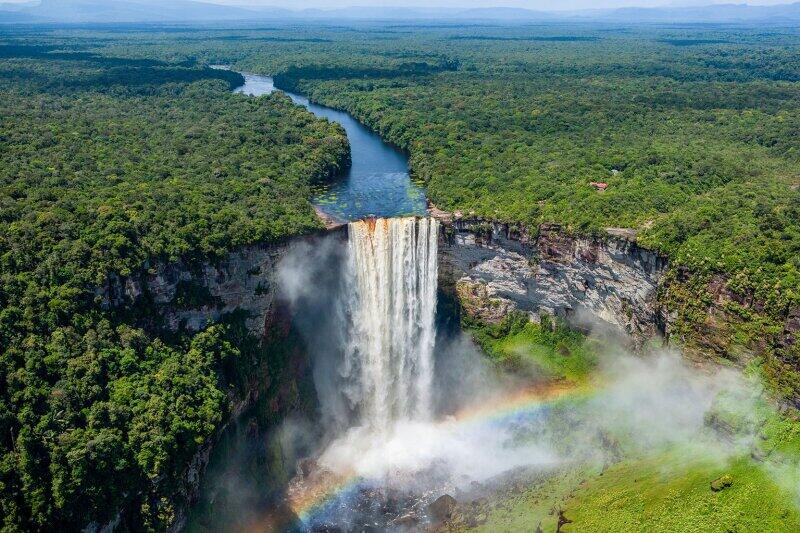
Images from one of the most remote and pristine waterfalls on Earth


Ancient geology shaped one of the most dramatic landscapes on Earth
Kaieteur Falls is located on the Potaro River in the Potaro-Siparuni region of central Guyana, deep within one of the largest tracts of undisturbed tropical rainforest remaining on the planet. The falls sit at the edge of a vast sandstone and conglomerate plateau that forms part of the Pakaraima Mountains, an ancient highland range that stretches across the borders of Guyana, Venezuela, and Brazil.
This plateau is part of the Guiana Shield, one of Earth's oldest geological formations, dating back approximately 1.7 billion years. The Guiana Shield is a Precambrian geological formation that underlies much of northeastern South America, and its ancient sandstone and quartzite table-top mountains, known as tepuis, are among the most distinctive geological features in the world. These flat-topped mountains rise abruptly from the surrounding lowland rainforest, creating isolated ecological islands that have evolved independently for millions of years.
The falls formed where the Potaro River, flowing gently across the relatively flat plateau surface, reaches the precipice and plunges 226 metres in a single, unbroken drop into the gorge below. Below the main drop, an additional series of steep cascades adds approximately 25 metres to the total descent, bringing the combined height to roughly 251 metres. The gorge itself is a dramatic chasm lined with exposed ancient rock faces, their layers telling a geological story spanning almost two billion years.
The width of the falls varies between 90 and 120 metres depending on the season, with the wet season between May and August producing the most dramatic flow. During peak flow, the volume of water pouring over the edge is so immense that it creates a permanent cloud of mist that rises hundreds of metres above the rim, visible from kilometres away. This mist sustains a unique micro-ecosystem of mosses, orchids, and the giant bromeliads that are home to the endemic Kaieteur Golden Frog.
The surrounding terrain is classic tepui landscape: flat-topped mountains and plateaus rising dramatically from dense lowland rainforest. The contrast between the open, windswept plateau at the top and the enclosed, humid gorge below creates distinct ecological zones within a remarkably small area. Standing at the rim, you look out over an unbroken canopy of primary rainforest stretching to the horizon in every direction, with no roads, no settlements, and no signs of human development visible anywhere.
Kaieteur's spray zone harbors species endemic to Guyana's highlands
Kaieteur Falls is not just a geological spectacle. It is one of the most ecologically significant sites in the Neotropics. The permanent mist cloud generated by the falls creates a hyper-humid microclimate that supports a community of plants and animals uniquely adapted to life in the spray zone. Several species found here exist nowhere else on the planet, making Kaieteur one of the most important sites for endemic biodiversity in all of South America.
The interplay between the falls, the ancient geology, and the surrounding pristine rainforest creates a layered ecosystem where each zone supports different species. From the golden frogs breeding in bromeliad tanks at the rim to the swifts nesting behind the curtain of water itself, Kaieteur's wildlife is as extraordinary as the waterfall that sustains it.
Endemic to Guyana's highlands, this tiny, brilliantly golden-yellow frog is the undisputed mascot of Kaieteur Falls. Measuring barely 2 centimetres in length, it lives its entire life cycle within the giant bromeliads that grow in the perpetual mist of the falls' spray zone. The frogs breed, lay their eggs, feed, and raise their tadpoles entirely within the water-filled tanks of these plants, never needing to touch the forest floor. Formally described by zoologist G.K. Noble in 1923 and named in honour of the naturalist William Beebe, the Kaieteur Golden Frog has become a symbol of the extraordinary biodiversity that thrives in Guyana's most remote places. Its dependence on the specific microclimate of the spray zone means it is exquisitely vulnerable to any changes in the falls' environment.
Endemic to GuyanaAmong the largest bromeliads in the world, these remarkable plants are the foundation of the entire Kaieteur spray zone ecosystem. Their massive rosettes of stiff, upward-pointing leaves can hold up to 20 litres of water in their central tanks, creating miniature aquatic worlds hundreds of metres above the rainforest floor. Each bromeliad is essentially a self-contained ecosystem: the water supports mosquito larvae, which feed the golden frog tadpoles, which eventually metamorphose into the adult frogs that patrol the leaf surfaces for insects. Scientists have documented entire food webs existing within a single plant. The bromeliads thrive in the constant mist and high humidity of the falls' rim, growing in dense clusters on exposed rock and thin soil where few other large plants can survive.
Micro-Ecosystem KeystoneOne of South America's most visually striking birds, the Guianan Cock-of-the-Rock is an icon of the Guiana Shield. The males are an intense, fiery orange with a prominent semicircular crest that covers nearly their entire head, making them look almost unreal against the green forest backdrop. They gather at communal display grounds called leks, usually on rocky ledges in the gorge near the falls, where they perform elaborate courtship dances to impress watching females. The males bow, jump, and fan their brilliant plumage while producing loud, piercing calls. The gorge area below Kaieteur Falls is one of the most reliable locations in Guyana to observe this spectacular behaviour. Females, by contrast, are a muted olive-brown, perfectly camouflaged for nesting on rock faces.
Icon of the Guiana ShieldOne of the most dramatic bird behaviours in the world plays out daily at Kaieteur Falls. The White-chinned Swift nests behind the curtain of falling water, building its nest on the wet rock face where the spray keeps everything perpetually damp. To reach its nest, the swift must fly directly through the wall of water — a feat requiring extraordinary speed, precision, and strength. Watching a flock of swifts circle above the falls before diving through the torrent is one of the most unforgettable wildlife spectacles at Kaieteur. The birds have evolved to thrive in this extreme niche, their compact bodies and powerful wings perfectly adapted for punching through the curtain of water at high speed.
Nests Behind the FallsThe 63,000 hectares of Kaieteur National Park protect a remarkable assemblage of South American megafauna. Jaguars, the largest cats in the Americas, patrol the forest floor, while Brazilian tapirs forage along riverbanks. Giant anteaters probe termite mounds in clearings, and family groups of giant river otters — the world's longest otters at up to 1.8 metres — hunt fish in the rivers and creeks that feed the Potaro. The park's birdlife is equally impressive, with over 200 species recorded within the park boundaries, including harpy eagles, king vultures, channel-billed toucans, and numerous species of hummingbirds, tanagers, and parrots. The sheer remoteness and lack of human disturbance make this one of the most intact large-mammal communities remaining in South America.
Protected WildernessCenturies of indigenous reverence and a sacrifice that gave the falls their name
Kaieteur Falls is far more than a geological feature. For the Patamona people, the indigenous Amerindian community who have lived in the Potaro-Siparuni region for centuries, the falls hold deep spiritual and cultural significance. The very name "Kaieteur" carries within it one of the most powerful oral traditions in Guyanese history — a story of sacrifice, courage, and the bond between a leader and his people.
The Patamona people have known and revered the falls for centuries, long before any European ever set foot in the interior of what is now Guyana. For the Patamona, the falls and the surrounding forest are not merely landscape features but living parts of a spiritual world. The Potaro River and its great waterfall figure prominently in their cosmology, and the area around the falls has been used for ceremonies, storytelling, and spiritual practice for generations beyond counting. The Patamona name for themselves translates roughly to "People of the Potaro," reflecting the deep connection between the community and the river system that defines their homeland.
According to Patamona oral tradition, the falls are named after an old chief called Kai, who made the ultimate sacrifice to save his people. When the warlike Caribishi tribe threatened to destroy the Patamona, Chief Kai sought the protection of Makonaima, the Great Spirit. Following a vision, Kai loaded his canoe with offerings and paddled it over the edge of the falls, sacrificing himself to appease the deity and secure divine protection for his people. The name "Kaieteur" translates as "Old Man's Fall" in the Patamona language, preserving Chief Kai's memory in the very name of the waterfall. Whether understood as history or legend, the story speaks to values of selfless leadership and the sacred relationship between the Patamona people and their land.
Charles Barrington Brown, a British geologist commissioned by the colonial government to survey the interior of British Guiana, became the first European to document Kaieteur Falls. Guided by Patamona people who had known the falls for generations, Brown reached the rim after an arduous journey through dense rainforest and along the Potaro River. His reports and sketches brought the first news of the falls to the outside world, describing a waterfall of staggering proportions hidden deep in the South American interior. Brown initially estimated the height at around 822 feet (later corrected to 741 feet, or 226 metres), and his accounts generated significant interest among geographers and naturalists in Europe.
Kaieteur National Park was officially established in 1929, making it Guyana's first national park and one of the oldest protected areas anywhere in South America. The park provided formal legal protection for the waterfall and its immediate ecosystem. The establishment reflected a growing recognition that Kaieteur Falls was not just a scenic wonder but a site of profound ecological and cultural significance that warranted permanent protection.
In 1999, the government of Guyana significantly expanded Kaieteur National Park to approximately 63,000 hectares. The expansion encompassed vast additional tracts of pristine Guiana Shield rainforest, critical watersheds feeding the Potaro River, and habitats for countless species of plants and animals. It was driven by growing scientific understanding of the park's exceptional biodiversity and the recognition that protecting the falls alone, without protecting the broader ecosystem that sustains them, would be insufficient.
Today, Kaieteur Falls and its surrounding national park are proposed for UNESCO World Heritage status, a formal step toward potential full World Heritage Site status. Tourism has grown steadily, with several air charter companies now offering day trips from Georgetown, making the falls accessible to international visitors for the first time in a meaningful way. At the same time, conservation efforts continue to balance growing visitor numbers with the need to protect the site's extraordinary natural values. The challenge for Guyana is to share Kaieteur with the world while preserving the very wildness and solitude that make it unique. So far, that balance has been maintained remarkably well — most visitors still find themselves nearly alone at the rim.
See how Kaieteur stacks up against the most famous waterfalls on the planet
| Waterfall | Height | Width | Flow Rate | Country | Single Drop? | UNESCO |
|---|---|---|---|---|---|---|
| Kaieteur Falls | 226m | 90-120m | 663 m³/s | Guyana | Yes | Proposed |
| Angel Falls | 979m | 150m | Low (seasonal) | Venezuela | Multi-tier | Yes |
| Niagara Falls | 51m | 1,203m | 2,400 m³/s | USA / Canada | No (3 falls) | No |
| Victoria Falls | 108m | 1,708m | 1,088 m³/s | Zambia / Zimbabwe | No (curtain) | Yes |
| Iguazu Falls | 82m | 2,700m | 1,746 m³/s | Argentina / Brazil | No (275 falls) | Yes |
Explore where Guyana's most spectacular waterfalls are located
Click to toggle waterfalls on/off
Two ways to reach the world's most powerful single-drop waterfall
The vast majority of visitors reach Kaieteur Falls by small aircraft, departing from Georgetown's Eugene F. Correia International Airport (commonly known as Ogle Airport). The scenic flight takes approximately one hour each way, crossing over miles of unbroken rainforest canopy before the falls come into view. It is one of the most spectacular approaches to any natural wonder in the world.
For those who want the full wilderness experience, a five-day guided trek through pristine rainforest offers something no flight can match: the feeling of the falls slowly revealing themselves after days of immersion in one of the most biodiverse forests on the planet. This is how Kaieteur was experienced for centuries, and it remains the most profound way to encounter the falls.
Everything you need to know for a smooth trip to Kaieteur Falls
February to April and August to November (dry seasons) offer the clearest skies, best visibility, and ideal photo conditions. The falls are spectacular year-round, but overcast skies can limit views during wet months.
Rain jacket (mist is constant), sturdy closed-toe shoes, camera with waterproof case or bag, binoculars, sunscreen, insect repellent, hat, and a water bottle. Pack light for the small aircraft.
Tropical climate, 24-28 degrees Celsius at the falls rim. Expect mist and spray near the edge. It is noticeably cooler at the rim than in Georgetown. Rain is possible at any time of year.
Small aircraft from Georgetown's Ogle Airport, approximately one hour each way. There are no roads to Kaieteur Falls. All visitors arrive by air or by multi-day overland trek.
There is no mobile phone coverage at Kaieteur Falls. Download offline maps, guides, and any content you need before departing Georgetown. Your phone's camera will still work.
There are no restaurants, shops, hotels, or ATMs at Kaieteur. Bring your own water and snacks. A basic restroom facility is available near the airstrip. That is the extent of infrastructure.
Answers to the most common questions about visiting Kaieteur Falls
Dive deeper into Guyana's incredible natural heritage
Booking, prices & what to expect
Explore more of the Land of Many Waters
Jaguars, harpy eagles & giant otters
Adventures, culture & experiences
Trusted guides & adventure companies
Maps, itineraries & travel tips
Read our complete tour booking guide with prices, operator comparison, and hour-by-hour itinerary.
View Tour Guide